11 August 2026
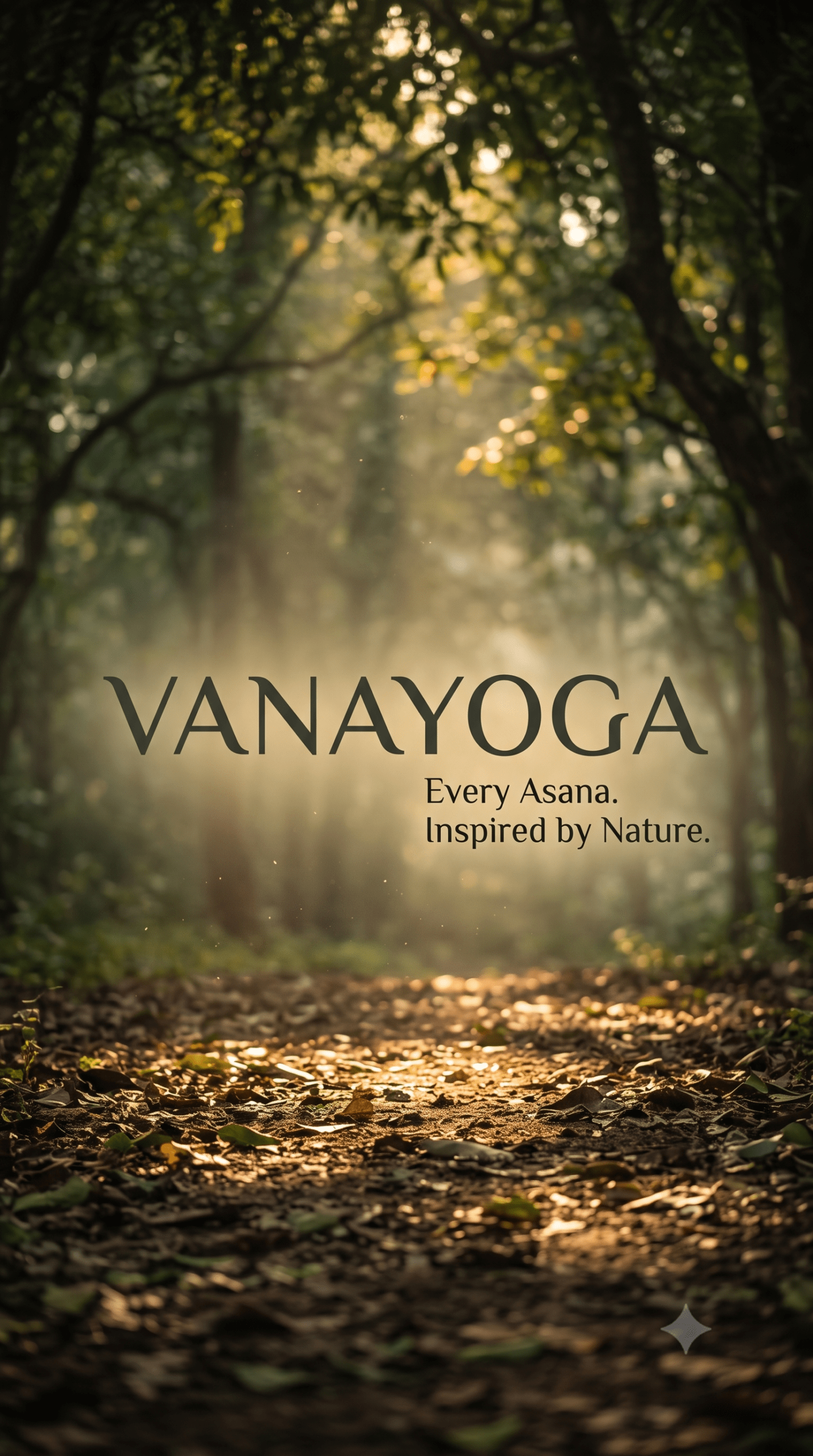
VANAYOGA: Why India’s Wildest Yoga Retreat Is Happening in the Tiger Forests of Pench

A Sense22 Yoga Experience — Where Yoga, Safari, and the Forests of Pench Meet
There is a particular kind of silence that only exists inside a forest at 6:30 in the morning — before the heat arrives, before the day's first vehicle starts its engine, when the only sound is a langur shifting its weight on a branch and your own breath finding its rhythm. This is the silence VANAYOGA is built around. Not a studio's hush, not a spa's ambient playlist — the real, old, original silence that yoga was born inside of, thousands of years before anyone rolled out a rubber mat under fluorescent lights.
VANAYOGA is a 3-day, 2-night wild yoga and safari retreat hosted by Sense22 Yoga, held on a forest-facing property on the edge of Pench Tiger Reserve in Madhya Pradesh, departing and returning from Nagpur. It is not a yoga class with a scenic backdrop. It is a full return — of yoga, to the wilderness it was quite literally observed, discovered, and named inside of; of the practitioner, to a pace of living that predates notifications and traffic; and of the retreat industry, to a level of curation that treats a retreat as an experience to be designed, not a package to be sold.
This is the story of why VANAYOGA exists, why it lives in Pench specifically, why a tiger safari belongs inside a yoga itinerary, what yoga's animal- and plant-rooted poses actually tell us about the practice's true origins, and why — if you trace the philosophy back far enough — you arrive at a sage named Dattatreya, who is said to have taken twenty-four gurus from the natural world itself. If you are searching for the best yoga retreat in India in 2026, a genuine wildlife safari yoga retreat, or simply a forest yoga retreat near Nagpur and Pench that does not feel manufactured, this is the long answer to why VANAYOGA belongs at the top of that search.
1. Yoga Was Never Meant to Be Indoors
Somewhere in the last hundred years, yoga moved indoors — into studios with mirrored walls, air conditioning, and carefully curated playlists. It became a fitness category, a real-estate line item, a subscription. None of that is wrong, exactly. But it is incomplete. Because yoga, as a practice and as a philosophy, was never conceived indoors. It was observed, tested, and refined outdoors — by rishis and wandering ascetics sitting under trees, on riverbanks, in caves, in forest hermitages called ashramas, watching the natural world with the kind of undistracted attention modern life rarely allows anymore. The oldest layers of the yogic and Vedantic tradition — the Aranyakas, literally "forest texts" — were composed and taught in forests. Aranya means forest in Sanskrit, and the Aranyakas represent a whole category of scripture meant to be studied away from the village, in wilderness, in silence. Yoga's philosophical scaffolding, in other words, has "forest" written into its foundation documents. The gurukul system, India's ancient model of education, was frequently forest-based: students left home, lived simply, and learned by observing nature as much as by listening to a teacher. This is the lineage VANAYOGA is reaching for. Not a marketing metaphor about "getting back to nature," but a literal, historically grounded act of practicing yoga the way it was practiced before buildings existed to practice it in. A yoga retreat in Pench is not an aesthetic choice. It is the closest a modern retreat can get to yoga's actual origin story.2. The Menagerie in Your Mat: Why So Many Yoga Poses Are Named After Animals and Plants
Here is something almost every yoga practitioner has said in a studio without pausing to think about it: cobra pose, cat-cow, downward dog, eagle pose, camel pose, pigeon pose, fish pose, locust pose, peacock pose, crane pose, tree pose, lotus pose. Take a moment to actually count how many of the poses in a standard yoga sequence are named after living things — animals, birds, insects, and plants. The number is startling. It is not decorative. It is the single biggest clue to how yoga was actually invented. Before yoga had a codified sequence, before it had a Sanskrit name for every posture, it had observers — ascetics sitting still enough, and for long enough, that the animal and plant world around them became their curriculum. Asana, in its earliest form, was less "invented" than noticed. A python's total stillness became a meditation posture. A cobra's spinal arch became a backbend. A tree's rootedness in wind became a balance pose. A peacock's improbable single-point balance became an arm-strength posture that still humbles advanced practitioners today. This is what nature-based yoga looks like when you trace it to its root: not humans imposing shapes onto the body, but humans copying shapes they witnessed in the wild and asking, "what does my body learn if I hold this?" A partial list of yoga's animal- and plant-rooted asanas — the ones you already know, whether you knew where they came from or not: Bhujangasana (Cobra Pose) the raised hood and arched spine of a cobra rising to strike, teaching the spine to open the way a threatened cobra opens. Adho Mukha Svanasana & Urdhva Mukha Svanasana (Downward-Facing Dog & Upward-Facing Dog) the exact stretch a dog performs on waking, one of the most literal poses in the entire practice. Marjariasana / Bitilasana (Cat-Cow Pose) the spinal wave of a cat arching and a cow dipping its back, still taught as the first thing many students ever learn. Vrikshasana (Tree Pose) balance and rootedness borrowed directly from what a tree does in wind: bend, don't break, and root deeper. Garudasana (Eagle Pose) named after Garuda, the eagle-king of Hindu mythology, teaching focus through a wrapped, off-balance shape. Matsyasana (Fish Pose) an homage to a fish's natural buoyancy and the arch of its body in water. Kurmasana (Tortoise Pose) the total withdrawal of a tortoise into its shell, used to teach pratyahara, the yogic practice of withdrawing the senses inward. Shalabhasana (Locust Pose) the low, hovering lift of a locust's body just above the ground. Mayurasana (Peacock Pose) one of the most demanding arm-balances in the practice, modelled on a peacock's poise. Simhasana (Lion Pose) a face and breath exercise that literally asks you to roar. Bakasana / Kakasana (Crane Pose / Crow Pose) a compact arm balance drawn from how these birds hold their weight over thin legs. Ustrasana (Camel Pose) a deep backbend inspired by the shape of a kneeling camel. Gomukhasana (Cow Face Pose) named for the shape the crossed legs and folded arms make, said to resemble a cow's face. Vrishchikasana (Scorpion Pose) an advanced inversion where the feet curl toward the head like a scorpion's raised tail. Padmasana (Lotus Pose) arguably yoga's single most iconic posture, modelled not on an animal but a plant: the lotus flower rising untouched out of muddy water, the tradition's central metaphor for spiritual purity emerging from a difficult world. Krounchasana (Heron Pose) and Vatayanasana (Horse Pose) lesser-known poses that continue the same pattern, right down to the intermediate and advanced end of the practice. Look at that list again. It is not a handful of cute names. It is close to the entire architecture of a yoga sequence — sun salutations aside — built from close, patient, outdoor observation of the animal and plant kingdom. This is precisely the insight VANAYOGA's own signature session, Pashu Asana Lab ("animal asana laboratory"), is built to restore: instead of learning a pose from a diagram, you learn it by being where the animal that inspired it might actually be standing.3. Lord Dattatreya and His Twenty-Four Gurus: The Original Nature-Based Yoga Philosophy
If animal-named asanas are yoga's body, the story of Lord Dattatreya is yoga's philosophical proof that nature itself was always considered a legitimate teacher — not a backdrop, not a metaphor, but a guru. Dattatreya is revered across Indian spiritual tradition as an avatar of the combined energies of Brahma, Vishnu, and Shiva, and as one of the earliest teachers of yoga, tantra, and the Avadhuta path of total, unattached realization. What makes his story so directly relevant to VANAYOGA is a passage, most famously recounted in the Bhagavata Purana's Uddhava Gita, where Dattatreya tells King Yadu that he is a "self-taught" sage — not because he learned from no one, but because he learned from everyone and everything, and openly names twenty-four gurus, almost none of whom are human. Traditionally, Dattatreya's twenty-four gurus are counted as the earth, air (vayu), sky (akasha), water, fire, the sun, the moon, a pigeon, a python (ajagara), the sea, a moth, a honeybee, an elephant, a honey-gatherer, a deer, a fish, the courtesan Pingala, an osprey (a bird seen carrying and then dropping its catch to avoid conflict), a child, a young maiden, a snake, an arrow-maker, a spider, and a wasp (or beetle). Every single one taught him something specific and non-negotiable: the earth taught patience under others' weight; fire taught transformation without attachment to what it burns; the honeybee taught the danger of hoarding, having gathered honey a beekeeper would simply take; the python taught contentment with whatever comes, without forcing pursuit; the child taught the freedom of a mind without ego or social performance; the spider taught that we spin our own worlds out of ourselves, and can just as easily withdraw them. This is, quite simply, the oldest and most authoritative precedent in the entire yogic tradition for the idea that the wild is not a location where yoga happens — the wild is a teacher of yoga, on equal footing with any human guru who ever lived. Dattatreya did not need an ashram of human disciples to attain mastery. He needed a forest, a riverbank, and the discipline to actually watch what was in front of him. This is exactly the pedagogy VANAYOGA is designed around: guided human instruction, yes, but structured so that the forest itself — its animals, its stillness, its unpredictability — gets to do some of the teaching too.4. Why Pench? The Forest That Inspired The Jungle Book
If yoga needed to be practiced in a forest again, it had to be the right forest — one with genuine ecological density, real wildlife, and its own mythology. Pench National Park and Tiger Reserve, straddling the border of Madhya Pradesh and Maharashtra along the Pench River, is one of the very few forests in India that can make that claim on every count. Pench sits within the Satpura mountain range, its deciduous teak forests famously said to have been the setting Rudyard Kipling drew on for The Jungle Book — a novel entirely about a boy raised by wolves, taught the "Law of the Jungle" by a bear and a panther, and mentored, at every turn, by animals rather than humans. It is difficult to imagine a more fitting literary backdrop for a retreat built on the premise that nature can be a guru. Pench is home to a healthy population of Bengal tigers, alongside leopards, sloth bears, Indian gaur, wild dogs (dhole), and more than 285 recorded species of birds — a biodiversity dense enough that a single early-morning safari can genuinely alter how a visitor relates to the idea of "wilderness" for the rest of their life. Pench is also close enough to Nagpur — roughly a two-hour drive — to make it logistically realistic for a 3-day retreat, without the multi-day travel burden of India's more remote wildlife corridors. This combination — real, dense, storied forest; a living tiger population; and workable access from a major city — is rare. It is why Pench, and not a generic "nature resort" anywhere else in India, is the location VANAYOGA was built around, not fitted into.5. Why a Safari Belongs in a Yoga Retreat
A tiger safari and a yoga session look, on paper, like two entirely different activities — one adrenaline, one stillness. In practice, they draw on the exact same internal skill: total, unhurried, undistracted presence. A safari cannot be rushed. You cannot scroll through it, multitask through it, or fast-forward it. You sit in a vehicle at dawn, in silence, attention fully outward, watching for a movement in grass that may or may not come. This is, functionally, an advanced exercise in dharana — one-pointed concentration — and pratyahara — withdrawal of the senses from everyday noise into a single field of attention. It is meditation with your eyes wide open. Ask anyone who has ever watched a tiger cross a forest trail in real silence, and they will tell you their mind was, for those thirty seconds, entirely and involuntarily empty of everything else. That is not a coincidence. That is the same state a strong seated meditation is trying to produce — arrived at, in the safari's case, by the sheer, magnetic presence of a wild animal rather than by breath-counting. VANAYOGA's morning safari is timed deliberately at first light, the same window classical yoga reserves for its most important practices — brahma muhurta, the hour before sunrise considered most conducive to a clear, undistracted mind. Breakfast is served en route, so the practice of presence extends from the safari straight into the meal itself. The safari is not a tourist add-on bolted onto a wellness itinerary. It is, if anything, the retreat's most intensive mindfulness session — it simply doesn't call itself one.6. Going Back to Where It All Started
Put the last three sections together and a single throughline emerges. Yoga's own poses are named after the animals and plants its earliest practitioners watched closely enough to imitate. Its own philosophical tradition — through Dattatreya's twenty-four gurus — explicitly credits nature, not human teachers alone, as a legitimate source of wisdom. And its own foundational texts were composed in forests, by people who had no studios, no mats, and no choice but to practice outdoors. VANAYOGA is not a new idea. It is the old idea, restored. A studio class with a plant in the corner is not what yoga once was. A three-day retreat where your first sit happens with your eyes open to a real tree line, where your breathwork is timed to actual forest air rather than air conditioning, where your asana session is barefoot on open lawn rather than on a rented mat between two strangers, and where your day includes a real tiger safari rather than a photograph of one on a studio wall — that is closer to it. This is why the retreat's own tagline is not a slogan but closer to a statement of fact: yoga was born in the wild — go back to where it began.7. The Sense22 Yoga Difference: Curating the World's Finest Experiential Retreats
A retreat is only as good as the discipline behind its curation, and this is where Sense22 Yoga earns the claim it makes for itself: that it exists to curate the world's finest experiential retreats, not simply to book venues and add a yoga instructor to the invoice. Sense22 Yoga is helmed by a founder who did not arrive at wellness by accident. With close to three decades inside the healthcare and pharmaceutical industry — including senior roles at some of India's most recognisable pharmaceutical companies — and an academic grounding that includes leadership programmes at INSEAD and the IIM Ahmedabad Advanced General Management Programme, Sense22 Yoga's founder made a deliberate, considered transition from corporate healthcare leadership into building a wellness company from first principles. That background matters more than it might first appear: a retreat curated by someone who has spent a career inside the discipline, rigour, and outcome-orientation of the healthcare industry is a retreat built the same way — with attention to physical safety, genuine wellness outcomes, and operational precision, not just aesthetics. Since its founding, Sense22 Yoga has built its offering around corporate yoga programmes, experiential retreats, and wellness products, with a consistent underlying philosophy: yoga is at its most powerful when it is taken out of the ordinary and placed somewhere the practitioner cannot help but pay attention. That philosophy is what produced VANAYOGA's four signature, in-house-designed practices — Pashavat Dharana, Vana Pranayama, Pashu Asana Lab, and Forest Nidra — none of which exist as generic templates borrowed from a studio manual. They were designed specifically for outdoor, forest-adjacent delivery, which is precisely the kind of ground-up curation that separates an "experiential retreat" from a hotel package with a yoga mat left in the room.8. Inside VANAYOGA: The Four Signature Practices
If you've never attended a choir-format concert before, here's a sense of what the evening will feel like:- Pashavat Dharana (Dawn) — A concentration practice modelled on animal stillness: the poised, total attention of a deer in the instant before it moves. Held outdoors, eyes open to the tree line, this is the retreat's first sit — grounding, with no agenda beyond presence.
- Vana Pranayama (Morning) — Forest breathwork, timed to the air itself: cooler, denser, and greener than anything a studio can recreate, with breath ratios adapted to the property's altitude, humidity, and canopy shade.
- Pashu Asana Lab (Midday) — Not a fixed sequence but an exploratory session: postures reverse-engineered from the very animals they are named after, practised barefoot, on open lawn, unhurried.
- Forest Nidra (Night) — Yoga nidra delivered entirely under open sky, with cricket-song standing in for a guided soundtrack. Most guests do not remember the ending. That is, deliberately, the point.
9. The Full VANAYOGA Itinerary — Day by Day
Day One — Arrival & Grounding (23 October) The retreat opens with a private transfer from Nagpur to the forest property at Pench, check-in to a forest-facing room, and a wholesome welcome lunch built from local, seasonal ingredients. After a short orientation to the retreat and property, the afternoon moves into a guided art therapy session — designed to help guests arrive fully, mind and body, before hi-tea is served alongside it. The evening closes with a bonfire and jungle talks, stories of the forest under open stars with resident naturalists, followed by a relaxed dinner. Day Two — Wild Encounters & Culture (24 October) The retreat's signature day begins at 6:30 AM with a morning safari in search of Pench's tigers, breakfast served en route. After returning to rest and reflect on the morning's sightings, a leisurely lunch is followed by a guided nature trail — an exercise in slowing down and noticing — and hi-tea. The evening moves into an Adivasi village tour, visiting a local tribal community and sharing a traditional culinary experience, before dinner and a closing sound healing session — a restorative sound bath under open sky. Day Three — Departure & Reflection (25 October) The retreat closes the way it opened: with a gentle sunrise yoga session for clarity and calm, followed by a final leisurely breakfast. After check-out, guests take a short detour to a local pottery village before the private transfer back to Nagpur concludes the retreat.10. Who VANAYOGA Is For
VANAYOGA is designed for both complete beginners and experienced practitioners — every session is guided, paced, and adapted to the group rather than assuming prior yoga experience. It is built for anyone who wants a genuine reset: professionals burned out on notifications and back-to-back calls, wildlife and nature enthusiasts who have never combined a safari with a wellness practice, and yoga practitioners curious what the practice feels like performed the way it was originally conceived — outdoors, unhurried, and in the actual presence of the animals its own poses are named after.11. What's Included, What It Costs, and How to Register
VANAYOGA is priced at ₹30,000 per person, based on twin-sharing, for the full 3-day, 2-night retreat (23–25 October 2026). This includes two nights in a forest-facing room, all meals (breakfast, lunch, hi-tea, and dinner), all four signature yoga and wellness sessions, the morning safari, the nature trail, the Adivasi village tour, a Sense22 welcome kit, and pick-up and drop-off from Nagpur. GST and applicable taxes, personal expenses, and a single-occupancy upgrade are billed separately. This is a non-refundable retreat; in the event of a genuine emergency, a booking can be shifted to the next announced batch, provided it falls within the same financial year (April–March). To register, prospective guests can call or WhatsApp +91 93243 78213, email sense22yoga.india@gmail.com, or reserve a slot with a deposit, which is confirmed within 48 hours.12. Frequently Asked Questions
Is VANAYOGA suitable for yoga beginners? Yes. All sessions are guided and adapted to the group's experience level — no prior yoga practice is required. Will I definitely see a tiger on the safari? No safari, anywhere in the world, can guarantee a specific sighting. Pench Tiger Reserve has a healthy, well-documented tiger population, and sightings are common, but they are part of the setting, not a promise. How do I get to the retreat? VANAYOGA includes a private transfer from Nagpur to the Pench property on Day One, and a return transfer from the property back to Nagpur on Day Three. What is Pashu Asana Lab? It is one of VANAYOGA's four signature sessions — an exploratory, outdoor asana practice that reconstructs postures from the animals they are named after, rather than following a fixed studio sequence. Why is it called VANAYOGA? Vana is the Sanskrit word for forest. VANAYOGA is, literally, "forest yoga" — a name chosen to reflect yoga's own forest-based origins rather than as a marketing flourish. Who curates VANAYOGA? VANAYOGA is a Sense22 Yoga retreat, curated by a founder with close to 29 years in healthcare and pharmaceutical leadership and academic credentials from INSEAD and IIM Ahmedabad, applying that same rigour to the design of experiential wellness retreats. What is the significance of Lord Dattatreya's twenty-four gurus to this retreat? Dattatreya's tradition of naming the earth, animals, and elements of nature as his gurus is one of the oldest philosophical precedents in Indian spiritual thought for treating the natural world as a legitimate teacher — the same principle VANAYOGA's forest-based sessions are built on.Stay Connected with Sense 22 Yoga
VANAYOGA · 23–25 October 2026 · Pench, Madhya Pradesh A Sense22 Yoga Retreat · +91 93243 78213 · sense22yoga.india@gmail.com Yoga was born in the wild. Go back to where it began.latest posts
1
11 August 2026
2
3
11 August 2026
4